
Is There an App That Tells You When Flight Prices Drop? A Data-Based Look at Flight Price Alerts


Nomadiq Flight Intelligence Report | July 2026
Yes. Several flight platforms can tell you when flight prices drop.
But there is a bigger question travelers rarely ask:
By the time you receive a flight price alert, is the lower fare still available?
Flight prices are not fixed numbers. Airline pricing and inventory systems can make different fare classes available or unavailable as demand and airline strategy change. IATA describes airline revenue management as a process where inventory teams open and close fare classes, pricing teams adjust fare classes based on demand and strategy, and forecasting systems continuously feed new information back into the process.
This means a flight price can move more than once between your first search and your final booking.
The real problem is no longer simply finding a flight.
It is deciding when to buy it.
Which apps tell you when flight prices drop?
Two widely used options are Google Flights and Skyscanner.
Google Flights allows travelers to track routes or individual flights. According to Google's own documentation, users can receive email or mobile notifications when tracked prices change significantly. Google may also notify travelers when prices are likely to rise or when a current fare may expire soon.
Skyscanner also offers flight Price Alerts. Travelers can track a route and specific travel date and receive an email when the price changes.
So the answer is clear.
Yes, apps can tell you when flight prices drop.
But price alerts solve only the information problem.
They do not necessarily solve the booking timing problem.
The difference between seeing a price drop and capturing it
Consider a hypothetical flight initially priced at ₹8,000.
| Fare observation | Flight price |
|---|---|
| First search | ₹8,000 |
| Price falls | ₹6,900 |
| Traveler receives alert | ₹6,900 |
| Traveler checks later | ₹7,600 |
| Final booking | ₹7,600 |
The lowest observed fare was ₹6,900.
The traveler booked at ₹7,600.
The traveler knew the price had dropped but still failed to capture the lowest observed price.
This example is illustrative, not a Nomadiq dataset result. It shows the difference between fare discovery and fare execution. That distinction is important when evaluating flight price alerts.
Why do flight prices keep changing?
Airline fares are influenced by inventory availability, fare classes, demand, airline pricing strategy, and forecasting systems.
IATA explains that airline inventory management can open and close different fare classes, effectively controlling how many seats are available at specific price levels. Pricing teams can then change fare classes based on demand and airline strategy.
This helps explain why searching for the same route on different days can produce different prices.
It also explains why there is no universal rule such as:
- "Always book on Tuesday."
- "Flights are cheapest at midnight."
- "Wait exactly 60 days."
Google's own historical analysis found only a 1.9% average price difference between buying on Tuesday, Wednesday, or Thursday versus Saturday or Sunday in the five years covered by that analysis.
The famous "best day to book" rule is much weaker than many travelers assume.
What does historical flight data tell us about booking timing?
Booking timing can matter, but the answer depends heavily on the market and route.
For example, Google's analysis of four years of aggregated Google Flights data for trips originating in the United States found that domestic prices were historically lowest around 38 days before departure, with a low-price range of 21 to 52 days before takeoff.
For international flights from the United States, average prices were lowest 101 days before departure, and the historical low-price range was 50 days or more before takeoff.
Google's 2025 holiday travel analysis later reported a 39-day domestic booking point and recommended 49 or more days for international travel in the scenarios it analyzed.
These numbers are useful. But they are aggregate historical observations.
They do not mean your Delhi to Bengaluru flight will definitely become cheapest exactly 39 days before departure.
Averages describe a dataset. Travelers book individual flights.
Price alerts vs flight price prediction
A price alert answers: "Did the price change?"
A flight price prediction attempts to answer: "Is the price likely to change?"
These are different problems.
Google Flights uses historical flight data to provide price insights when sufficient information is available. Google has described using machine learning and statistical analysis of historical flight data to surface booking guidance and identify fares that appear lower than normal.
Nomadiq approaches the problem through fare monitoring and flight price intelligence. Our goal is not simply to tell a traveler that a fare changed. The more useful questions are:
- How frequently did the fare move?
- How large was the price drop?
- How many days before departure did it happen?
- Did the price fall again?
- How long did the lower fare remain observable?
- Would waiting have saved money, or would waiting have increased the final booking price?
These are the questions the Nomadiq Flight Intelligence Report is designed to study.
What is Nomadiq Smart Booking?
Nomadiq's Smart Booking is built around a different idea.
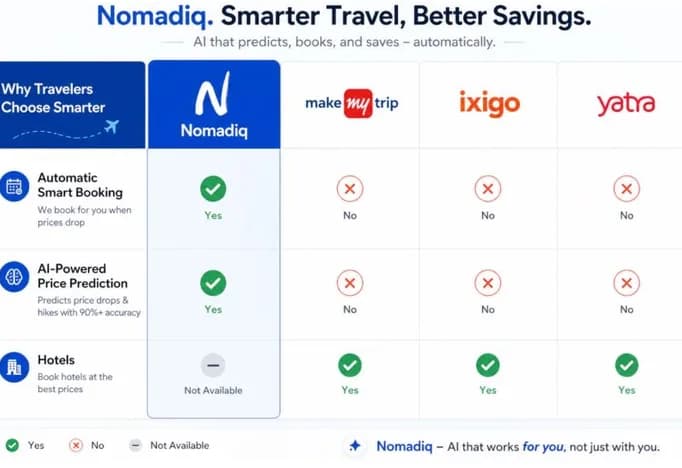
Instead of asking travelers to repeatedly react to flight price changes, a traveler defines their flight and booking preferences. Nomadiq monitors eligible fares. When the booking conditions are satisfied, Smart Booking can complete the booking automatically.
The difference is simple.
| System | Detects price movement | Tells traveler | Can act on booking conditions |
|---|---|---|---|
| Traditional fare search | No continuous tracking | No | No |
| Price alert | Yes | Yes | No |
| Price prediction | Estimates future movement | Provides guidance | No |
| Nomadiq Smart Booking | Monitors fares | Not required | Yes |
This is why we believe flight booking is moving from search to monitoring, and eventually from monitoring to execution.
So, what is the best app for flight price drop alerts?
If your goal is to receive notifications when prices change, Google Flights and Skyscanner both provide price tracking features. Their official documentation clearly describes email or mobile alert functionality.
If your problem is that you do not want to manually react every time a flight price changes, that is a different use case.
That is the problem Nomadiq Smart Booking is designed to address.
Frequently Asked Questions
Is there an app that tells you when flight prices drop? Yes. Google Flights and Skyscanner offer flight price tracking and price alerts. Nomadiq also monitors flight fares through its Smart Booking system.
Can I get a notification when a flight becomes cheaper? Yes. Flight price tracking platforms can send notifications or emails when tracked fares change.
Can an app automatically book a flight after the price drops? Nomadiq Smart Booking is designed to monitor eligible fares and complete a booking when the traveler's selected booking conditions are met.
Can you predict whether flight prices will fall? Flight price prediction systems can analyze historical and current pricing signals, but no prediction system can guarantee a future fare. Airline pricing depends on changing inventory, demand, fare classes, and pricing strategy.
Should I book a flight now or wait for a price drop? There is no universal answer. Historical booking windows can provide context, but route-level fare movement matters. The current price, days before departure, historical fare behavior, and observed price volatility should all be considered.
Methodology and data note
This report combines publicly documented information from Google Flights, Skyscanner, and IATA with Nomadiq's approach to fare monitoring and Smart Booking.
Industry statistics cited in this report are attributed to their original sources. Examples marked as hypothetical are illustrative and should not be interpreted as observed Nomadiq fare data.
Future editions of the Nomadiq Flight Intelligence Report will publish route-level observations from Nomadiq's own fare monitoring dataset, including fare drop distributions, days-to-departure analysis, and booking timing simulations.
Final answer
Yes, there are apps that tell you when flight prices drop.
Google Flights and Skyscanner can track fare changes and send alerts.
But the next problem in flight booking is not detecting a lower price. It is capturing the booking opportunity when it appears.
That is the problem Nomadiq is working on.

co-founder @ nomadiq | building ai-powered travel tech.
Let Nomadiq watch the price for you
Set your trip, set your target. We monitor 24/7 and auto-book when the fare drops to where you want it.
Keep reading
Does Any App Buy Flight Tickets When Prices Fall?

Is There a Platform That Lets You Book Flights Automatically When Prices Drop?

Is There a Way to Tell if Flight Prices Will Drop? A Data-Based Look at Airfare Prediction